The expansion of reliable road networks across rural Latin America represents a critical step toward regional economic integration and social equity. Connecting isolated agricultural communities with centralized urban markets requires durable, all-weather paving solutions capable of enduring extreme climate patterns and heavy commercial transit. However, executing large-scale concrete paving projects in remote regions presents severe logistical bottlenecks that frequently strain municipal budgets and delay project timelines.
Historically, infrastructure developers relied on standard transit mixer trucks supplied by centralized commercial batching plants. In rural territories, this model is highly inefficient due to long transport distances over unpaved, mountainous paths, which often cause concrete segregation and premature setting before arrival. Consequently, evaluating the self-loading concrete mixer price(hormigonera autocargable precio) has become a primary focus for regional contractors seeking a decentralized, highly mobile alternative that can produce fresh, high-specification concrete directly at the pouring site.
By integrating material loading, computerized weighing, high-speed mixing, and multidirectional placement into a single four-wheel-drive chassis, this innovative machine type is rapidly replacing traditional logistics fleets. For small to medium infrastructure companies working in tough environments, the self-loading concrete mixer offers an independent production hub. They allow teams to bypass commercial ready-mix suppliers entirely, cutting down project timelines and significantly lowering total equipment investment costs across remote development zones.
The Logistical Reality of Rural Paving Projects
Rural road construction in Latin America involves navigating tight mountain passes, muddy river crossings, and severe high-altitude conditions. For a traditional transit mixer, these environments present major safety and structural hazards. Heavy, conventional trucks frequently get stuck on unpaved roads, and the long transit times make it difficult to maintain the required concrete slump, leading to weaker pavement sections and cold joints in the finished highway network.
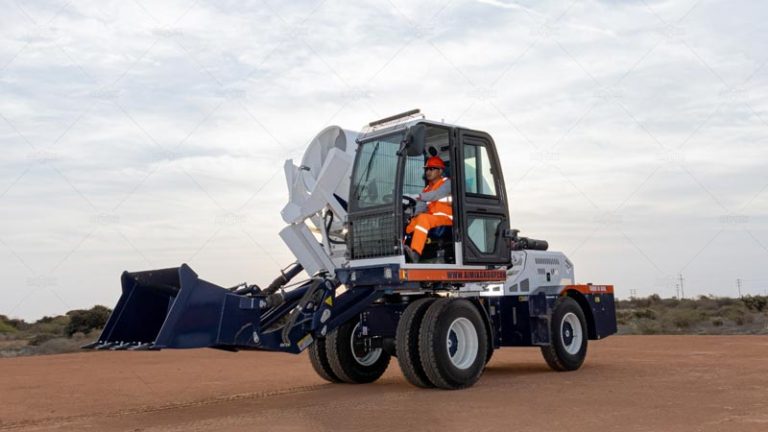
In contrast, an all-terrain self-loading concrete mixer features a compact wheelbase and an articulated steering system, allowing it to navigate sharp bends and narrow dirt tracks with ease. Because the raw ingredients—cement bags, sand, aggregates, and water—can be stockpiled at convenient intervals along the advancing road corridor, the machine operates as a moving batch plant, mixing fresh concrete exactly where it is poured to eliminate transit delays.
Technological Advances Transform Engineering Standards
The rapid adoption of these vehicles across the Andean region is driven by recent technological advances in self-loading concrete mixers(impulsado por los recientes avances tecnologicos de autohormigoneras). Modern units are no longer simple mechanical mixers; they are smart, mobile production assets engineered to meet strict international building codes and high mechanical durability standards.
Automated Electronic Weighing Systems
Older mobile mixing methods struggled with maintaining consistent material ratios, often leading to variations in concrete strength. Today, thanks to technological advances in self-loading concrete mixers, modern units feature onboard hydraulic loading buckets equipped with digital weight sensors and programmable microprocessors. The operator selects the desired concrete class via an in-cabin terminal, and the system guides the loading process, automatically calculating aggregate weights and adjusting the water-to-cement ratio in real time with a minimal margin of error.
To visualize how these advanced mechanical configurations compare with traditional transit truck setups during rural deployment, consider the operational breakdown below:
| Operational Metric | Traditional Transit Mixer Fleet | Advanced Self-Loading Configuration | Impact on Rural Project Delivery |
|---|---|---|---|
| Auxiliary Machinery | Requires external wheel loaders & static batch plant | Completely self-contained (Zero external loaders needed) | Drastically lowers equipment transportation overheads |
| Labor Allocation | 5 to 7 workers (operators, batchers, drivers) | 1 single machine operator | Reduces on-site labor dependencies by over sixty percent |
| Terrain Capability | Limited to paved or well-graded access roads | 4×4 off-road drive with high ground clearance | Enables paving in remote, unpaved mountainous zones |
| Material Freshness | High risk of slump loss during long haul transits | Mixed on-demand directly at the point of discharge | Eliminates structural cold joints and premature setting |
Omnidirectional Drum Rotation and Placement
Another major structural upgrade is the integration of sleek 270-degree slewing drums. This allows the mixing unit to swing dynamically to either side of the vehicle chassis, discharging fresh concrete into roadside drainage ditches, retaining walls, or lane expansions without requiring the driver to reposition the truck constantly. This agility is especially useful on narrow cliffside corridors where turning a large vehicle around is physically impossible.
Economic Viability: Analyzing the Price-to-Performance Ratio
When municipal planners and private contractors assess their procurement options, the upfront self-loading concrete mixer price is evaluated against the machine’s long-term operational savings. While the initial capital cost of a smart self-loading unit is higher than a simple, passive transit drum, it eliminates the need to buy or lease separate wheel loaders, weigh stations, and towing trucks.
Furthermore, because a single self-loading concrete mixer handles the loading, batching, and pouring workflows independently, daily operational costs drop sharply. Contractors report achieving a full return on investment within eight to twelve months, depending on the scale of the paving project. This rapid payback makes it a highly attractive option for medium-sized enterprises looking to scale their operations across price-sensitive regional markets where controlling the overall self-loading concrete mixer price determines project profitability.
Regional Focus: Demands in Challenging Territories
The shift toward modular, self-contained mixing fleets is highly visible across specific emerging markets, with particular momentum building for the specialized self-loading concrete mixer Chile(autohormigonera Chile) infrastructure teams deploy. Chile’s strict environmental regulations and high safety standards for mining and public works have accelerated the shift toward intelligent, low-emission diesel engines and certified rollover protection cabins on mobile machinery.
Operating a self-loading concrete mixer Chile models feature allows contractors to work comfortably in high-altitude Andean sectors where traditional concrete supply lines freeze up or fail. This strict regulatory and geographical environment has influenced neighboring countries like Peru, Bolivia, and Colombia, where contractors are adopting similar equipment profiles to future-proof their operations against anticipated local standard adjustments.
The core financial and practical benefits of adopting these autonomous units across the continent include:
- Reduced Logistical Expenses: Eliminating long-distance ready-mix hauls cuts down truck fuel consumption and lowers maintenance costs across the support fleet.
- Zero Material Waste: On-demand mixing ensures that only the exact volume of concrete needed for a specific road segment is produced, avoiding the costly disposal of over-ordered batch mixes.
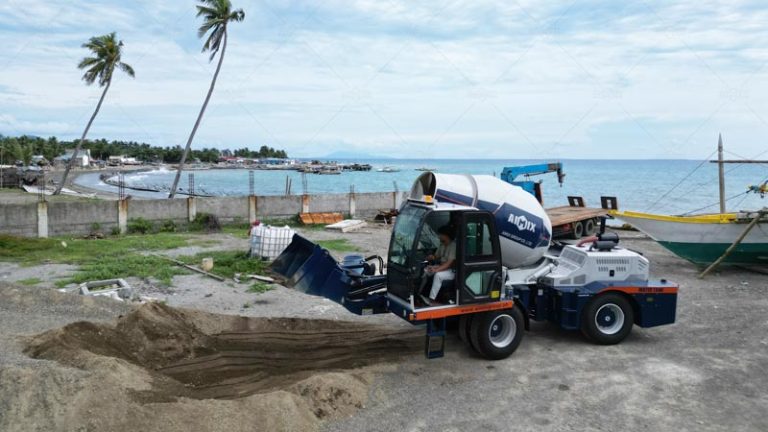
- High Equipment Utilization: Once a road project is complete, the machine can drive directly onto a low-boy trailer and move to a rural building site or bridge foundation job without needing dismantling.
Future Outlook for Infrastructure Development
As international financing for infrastructure increasingly relies on meeting strict environmental, social, and governance criteria, the dry-batching capability of the modern self-loading concrete mixer(capacidad de dosificación de la moderna concretera autocargable)—which prevents water contamination and riverbed damage—makes it the preferred choice for green road building initiatives. The integration of advanced diagnostics further enhances this value by keeping emissions under tight control.
Ultimately, the transition from large centralized transit fleets to agile, self-contained mixing units marks a major step forward for rural infrastructure development across Latin America. By combining the loading, precise weighing, and pouring stages into an all-terrain machine, contractors can deliver high-quality, long-lasting concrete pavements under demanding environmental conditions. As continuous technological advances in self-loading concrete mixers lower the entry barriers, these versatile machines will remain a cornerstone of sustainable development, helping to transform isolated rural routes into thriving economic corridors.